
Famous Mathematicians
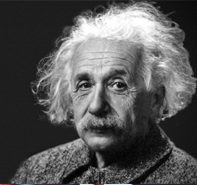
Albert Einstein
Albert Einstein 14 March 1879 – 18 April
1955) was a German-born theoretical physicist who
developed the theory of relativity, one of the two pillars
of modern physics (alongside quantum
mechanics).:274 His work is also known for its
influence on the philosophy of science. He is best
known to the general public for his mass–energy
equivalence formula E=mc2, which has been dubbed
"the world's most famous equation". He received the
1921 Nobel Prize in Physics "for his services to
theoretical physics, and especially for his discovery of the
law of the photoelectric effect", a pivotal step in the
development of quantum theory.
Near the beginning of his career, Einstein thought that
Newtonian mechanics was no longer enough to reconcile
the laws of classical mechanics with the laws of the
electromagnetic field. This led him to develop his special
theory of relativity during his time at the Swiss Patent
Office in Bern (1902–1909). He subsequently realized
that the principle of relativity could be extended to
gravitational fields, and published a paper on general
relativity in 1916 introducing his theory of gravitation. He
continued to deal with problems of statistical mechanics
and quantum theory, which led to his explanations of
particle theory and the motion of molecules. He also
investigated the thermal properties of light and the
quantum theory of radiation, the basis of laser, which laid
the foundation of the photon theory of light. In 1917, he
applied the general theory of relativity to model the
structure of the universe.
[Wikipedia]
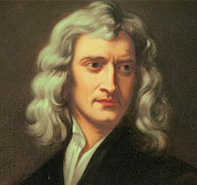
Sir Isaac Newton
Sir Isaac Newton (25 December 1642 – 20 March 1726/27) was
an English mathematician, physicist, astronomer, theologian, and author
(described in his own day as a "natural philosopher") who is widely
recognised as one of the most influential scientists of all time, and a key
figure in the scientific revolution. His book Philosophiæ Naturalis
Principia Mathematica (Mathematical Principles of Natural
Philosophy), first published in 1687, laid the foundations of classical
mechanics. Newton also made seminal contributions to optics, and
shares credit with Gottfried Wilhelm Leibniz for developing the
infinitesimal calculus.
In Principia, Newton formulated the laws of motion and universal
gravitation that formed the dominant scientific viewpoint until it was
superseded by the theory of relativity. Newton used his mathematical
description of gravity to prove Kepler's laws of planetary motion,
account for tides, the trajectories of comets, the precession of the
equinoxes and other phenomena, eradicating doubt about the Solar
System's heliocentricity. He demonstrated that the motion of objects on
Earth and celestial bodies could be accounted for by the same principles.
Newton's inference that the Earth is an oblate spheroid was later
confirmed by the geodetic measurements of Maupertuis, La Condamine,
and others, convincing most European scientists of the superiority of
Newtonian mechanics over earlier systems.
[Wikipedia]

