
Famous Mathematicians

Leonhard Euler
Leonhard Euler ( 15 April 1707 –18 September 1783) was a Swiss mathematician, physicist,
astronomer,geographer, logician and engineer who made important and influential discoveries in many branches of
mathematics, such as infinitesimal calculus and
graph theory, while also making pioneering contributions to several branches such as topology and analytic number theory.
He also introduced much of the
modern mathematical terminology and notation, particularly for mathematical analysis, such as the notion of a mathematical
function. He is also known for
his work in mechanics, fluid dynamics, optics, astronomy and music theory.
Euler was one of the most eminent mathematicians of the 18th century and is held to be one of the greatest in history. He is
also widely considered to be the
most prolific mathematician of all time. His collected works fill 92 volumes,more than anyone else in the field. He spent
most of his adult life in Saint
Petersburg, Russia, and in Berlin, then the capital of Prussia.
[Wikipedia]
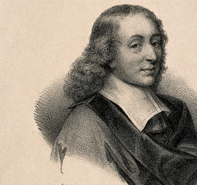
Blaise Pascal
Blaise Pascal(19 June1623 – 19 August 1662) was a French mathematician, physicist, inventor, writer and Catholic
theologian. He was a child prodigy who was educated by his father,
a tax collector in Rouen. Pascal's earliest work was in the natural and applied
sciences where he made important contributions to the study of fluids, and
clarified the concepts of pressure and vacuum by generalising the work of
Evangelista Torricelli. Pascal also wrote in defence of the scientific method.
In 1642, while still a teenager, he started some pioneering work on calculating
machines. After three years of effort and 50 prototypes, he built 20 finished
machines (called Pascal's calculators and later Pascalines) over the following 10
years, establishing him as one of the first two inventors of the mechanical
calculator.
Pascal was an important mathematician, helping create two major new areas of
research: he wrote a significant treatise on the subject of projective geometry at
the age of 16, and later corresponded with Pierre de Fermat on probability
theory, strongly influencing the development of modern economics and social
science. Following Galileo Galilei and Torricelli, in 1647, he rebutted Aristotle's
followers who insisted that nature abhors a vacuum. Pascal's results caused many
disputes before being accepted.
[Wikipedia]

